
What is in the game
Everything it actually does
The rules are public; the world is not. Everything on this page is something the game does the same way for everybody — what nobody will tell you is where anyone lives, what they hold, and what they are about to do.
What it actually looks like
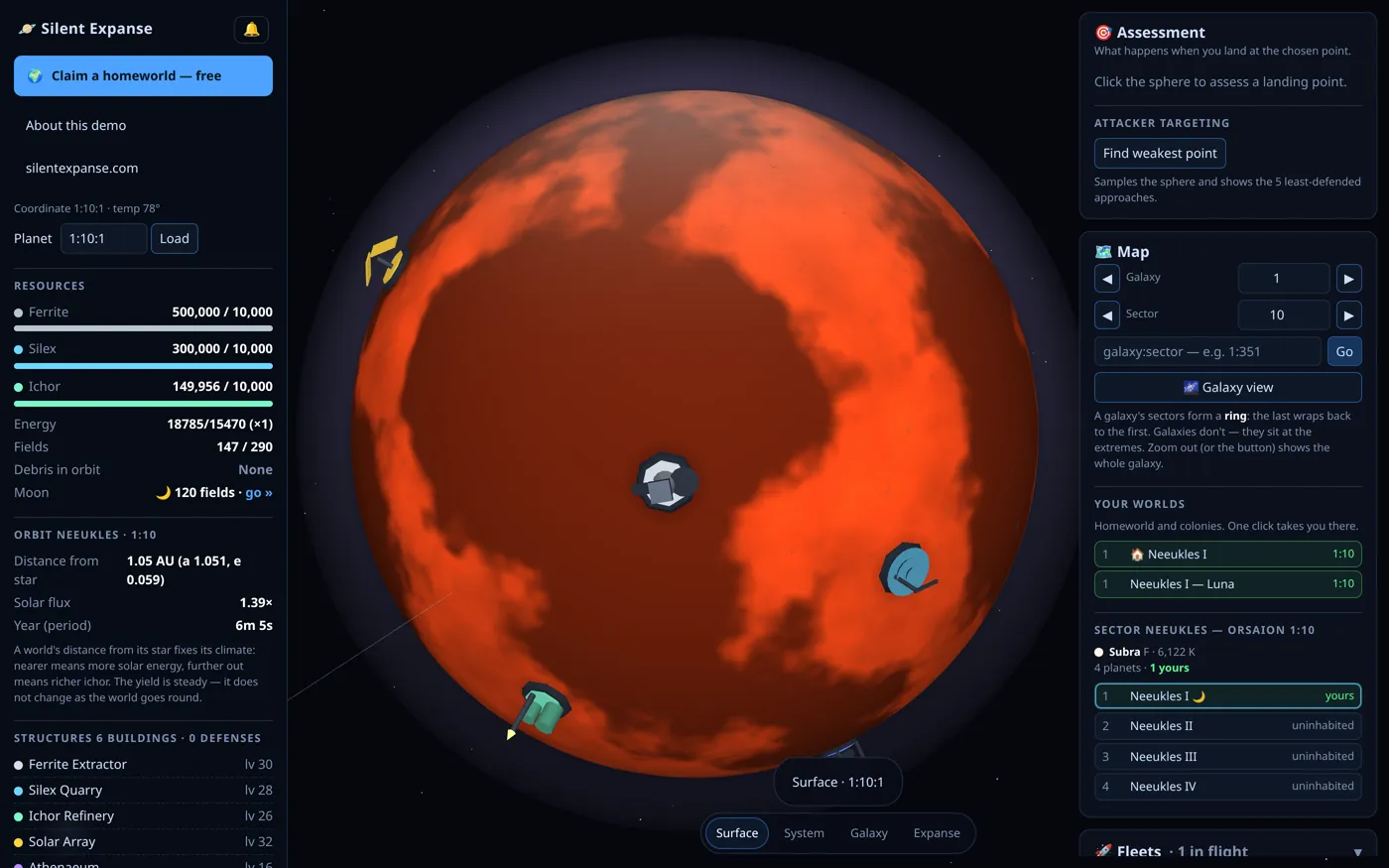
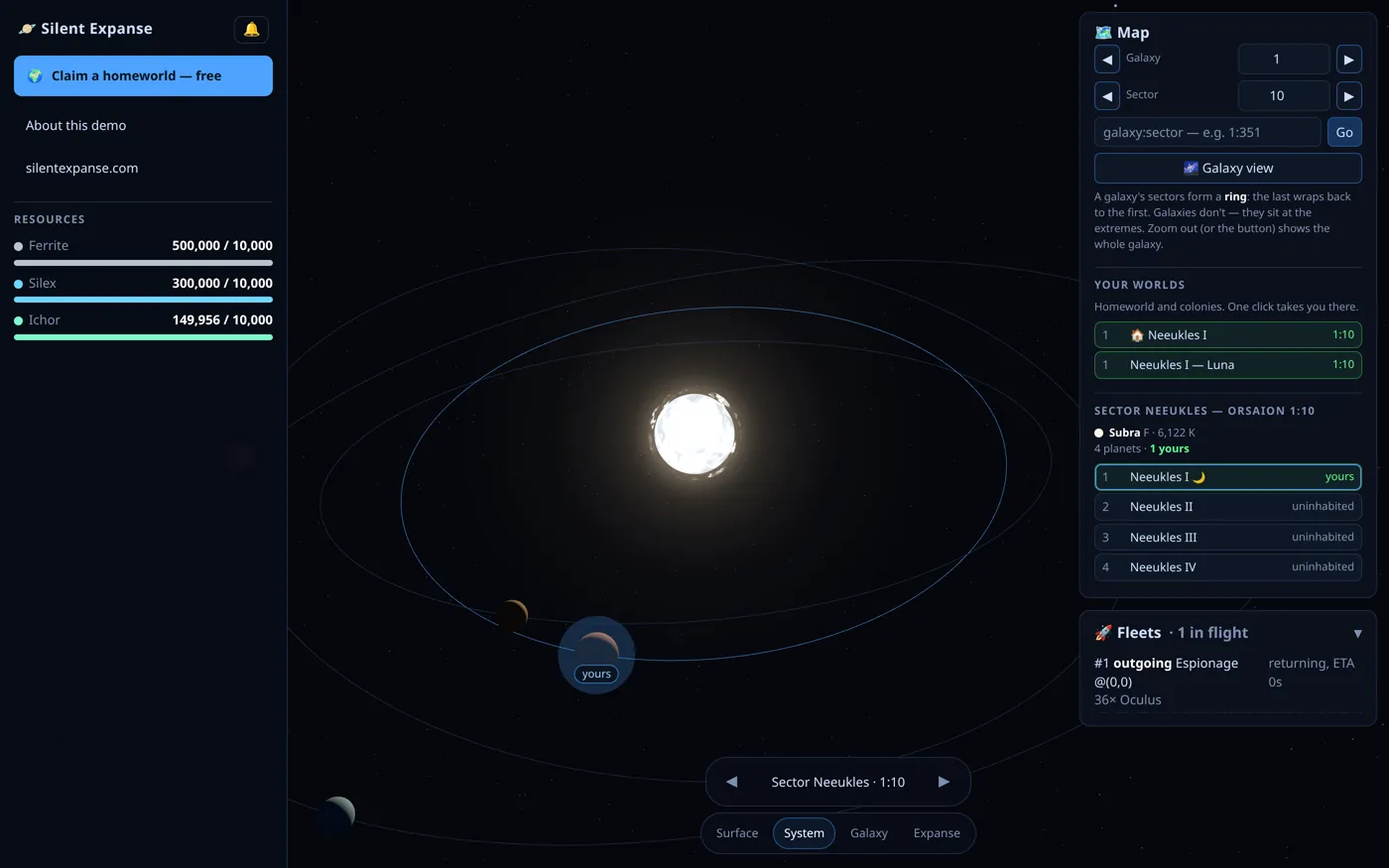
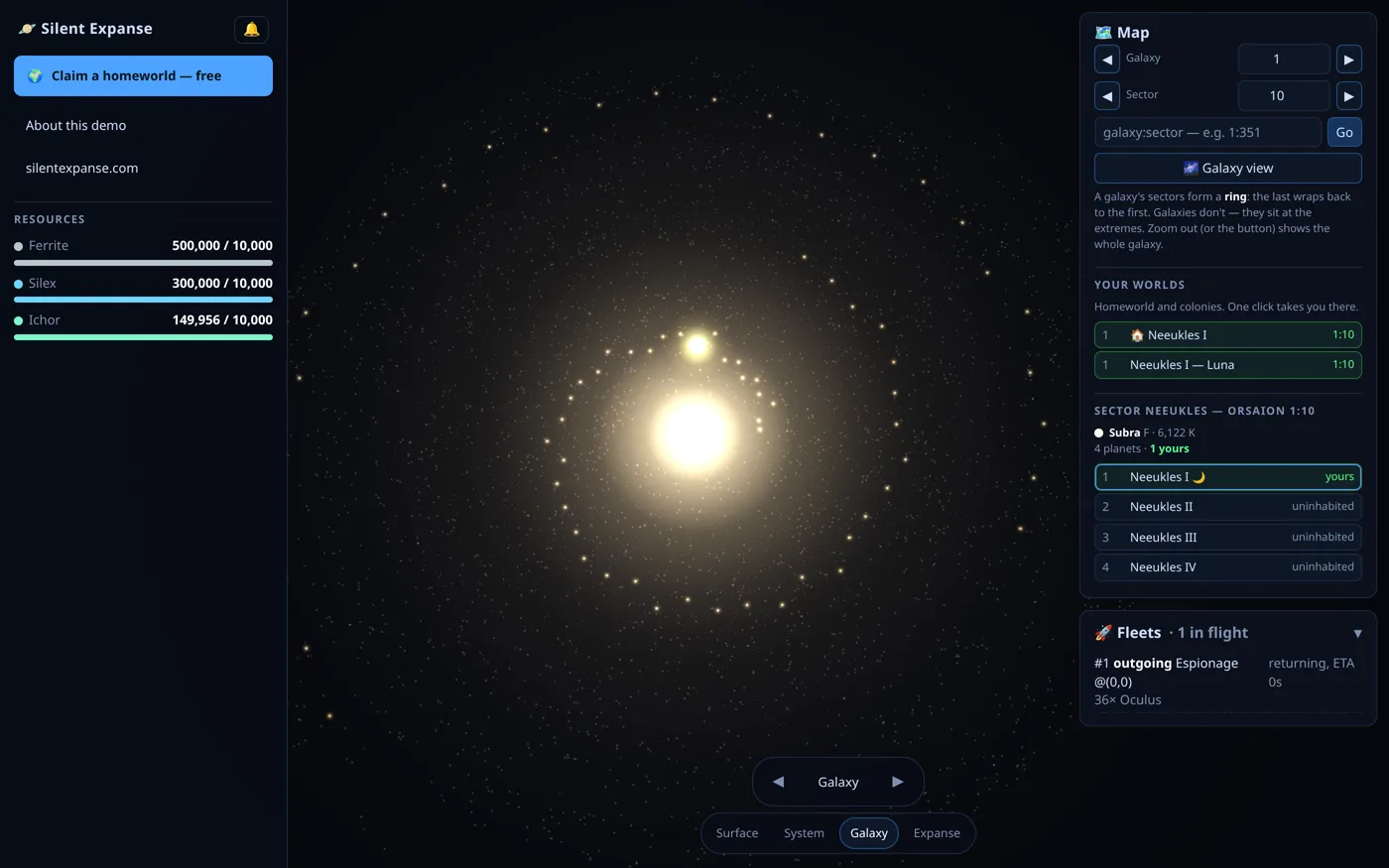
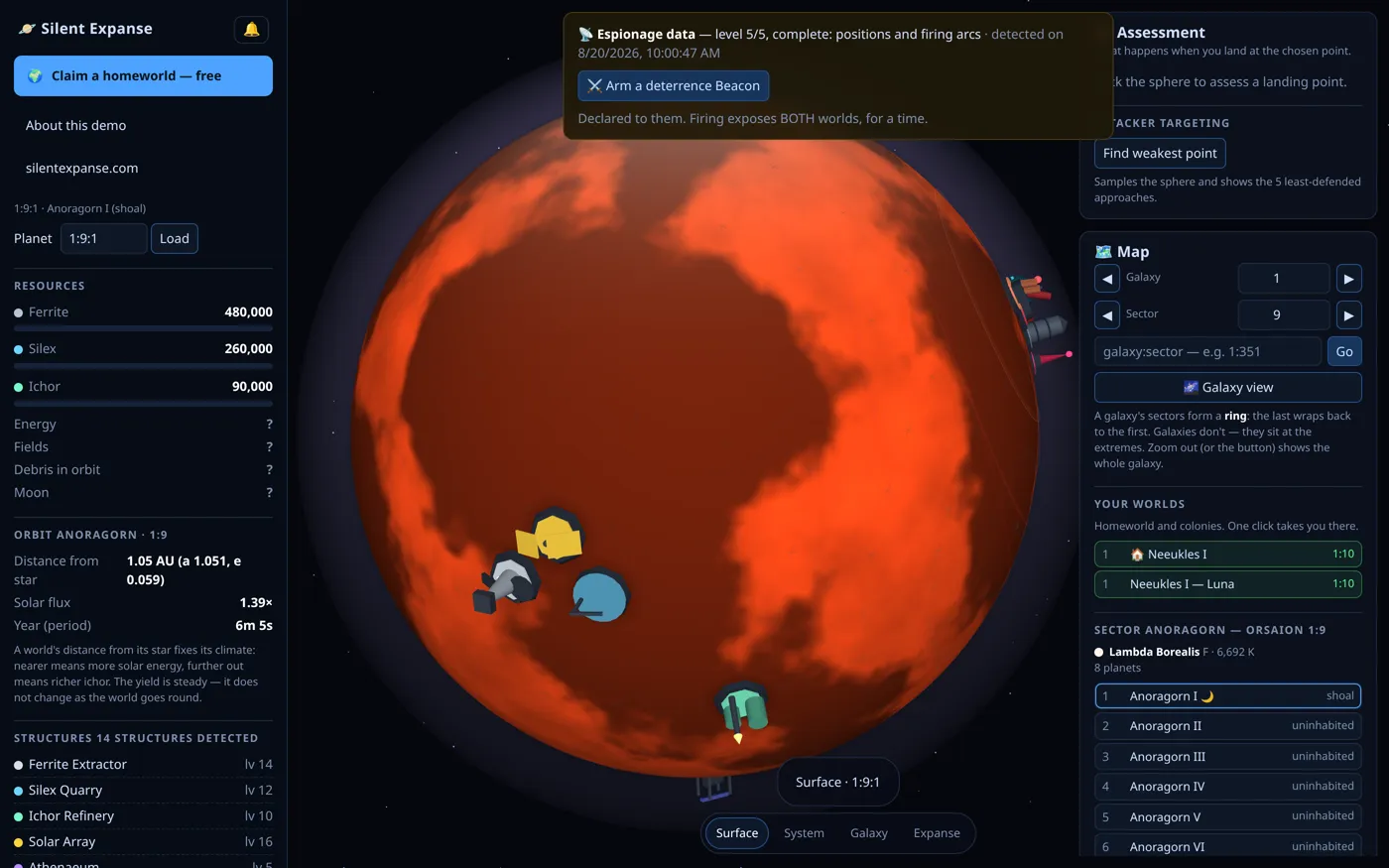
Not renders. These are frames from the demonstration world, which you can open yourself, right now, without an account.
Worlds are spheres, and they move
Every world is a globe you build on at a point — latitude and longitude — with a minimum distance between structures, so where you put things is a decision you cannot take back. Each system has its own star and its own orbital band; planets trace real ellipses in real time, and their distance from that star decides temperature, solar power and what the ground yields. Battles leave debris in orbit, and out of a big enough field a moon can condense: a second body at the same address, with its own surface to arm.
Where you live decides your economy
Three resources, mines that compete with each other for power, and two ways to keep the lights on: solar collapses as you move away from the star, fusion ignores it and burns fuel that cold worlds happen to be rich in. So the outer dark is playable, and it is a choice rather than a punishment. Ground is finite — every building level costs a field — so a world has a size, and a world's size is worth scouting.
The battle is decided by where you land
Defences are emplacements on the surface, each covering an arc of sky. Only the ones whose arc reaches your landing point ever fire — land in a gap and a fortress never touches you; pick the wrong spot and the same fleet is torn apart. The stationed fleet is the mobile half: it defends wherever the enemy comes down, and it dies there. Combat is deterministic and seeded, rapid fire rewards composition, and batteries mostly rebuild afterwards — a raid takes your resources, not your civilisation.
You cannot attack blind
Of somebody else's world you read nothing live. The only way to learn where the guns are is to send probes, and what comes back depends on the gap between your reconnaissance and theirs — resources, then their fleet, then their defences, then their buildings, and only at the top the positions that let you draw their surface and choose your landing point. More probes narrow the gap but never close it, the defender is told they are being watched, and their batteries shoot probes down for as long as the scan lasts. And every report is a photograph: it goes stale, and what rots first is the detail.
The Simulator plans the raid for you
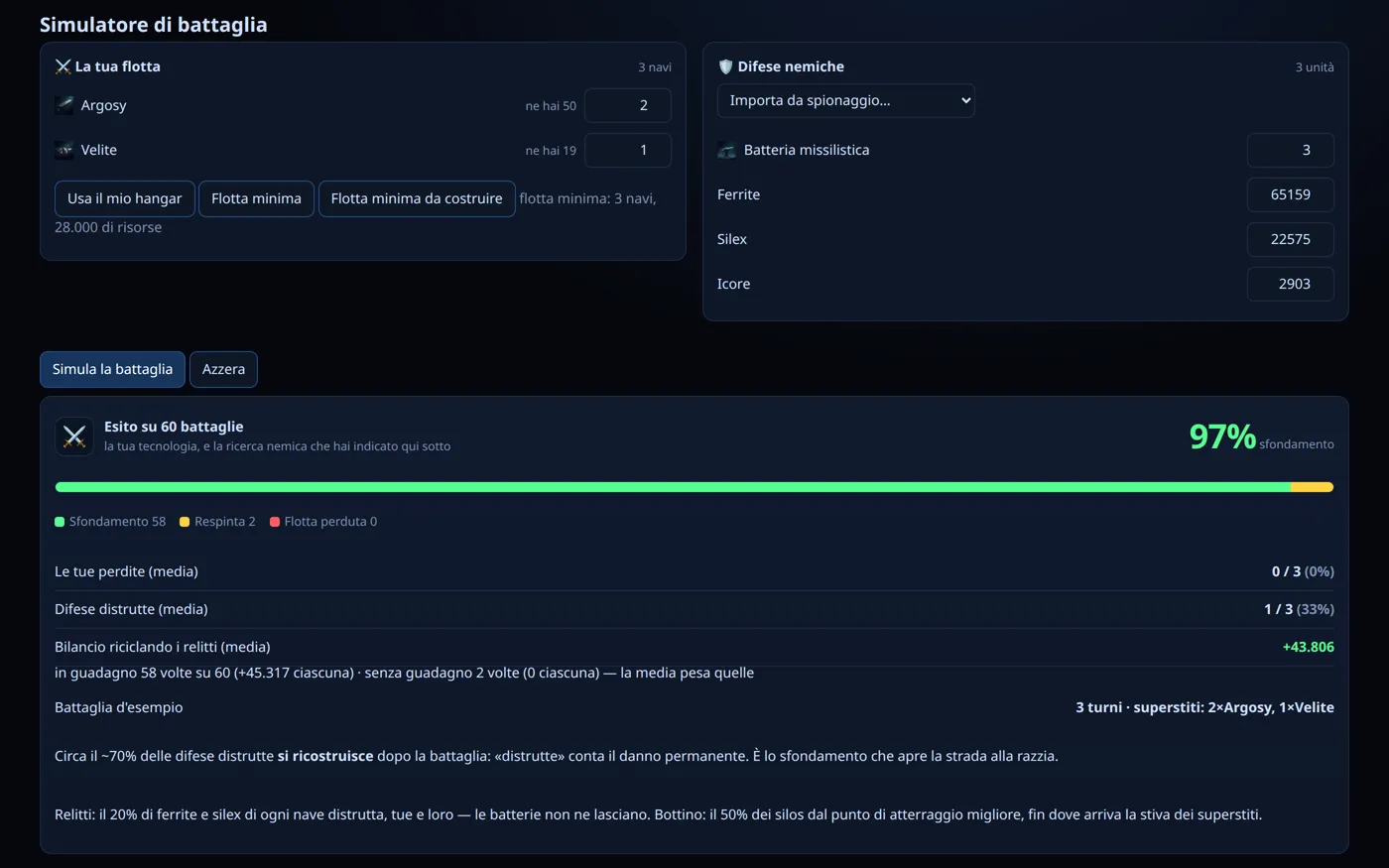
Enter the defences you expect — or import an espionage report, silos included — and one button searches for the cheapest fleet that breaks through, pays for itself and carries the loot home. Paying for itself is the rule that matters: the wrecks you can recycle plus what the raid lifts must cover what you lose, and batteries leave no wreck, so a fortress with empty silos is not worth flying at. A second button asks the same question over the hulls you have unlocked rather than the ones you own, which is how you find out what to build next. Sixty simulated battles follow, and the card says in plain words how many times the raid earned and by how much.
The map is not given to you
You start able to see your own world and its star, and nothing else. Sensor research opens a radius around what you hold, survey buoys go out and chart a sector permanently, and simply flying somewhere charts the sectors you crossed — privately, that one, because a fly-over is your own sight and not the alliance's. What you can see is what you can colonise. The view goes from a planet's surface out through its system to the ring of a galaxy and then to the galaxies themselves, where the honest thing it renders is how little you know.
Seven things a fleet can be sent to do
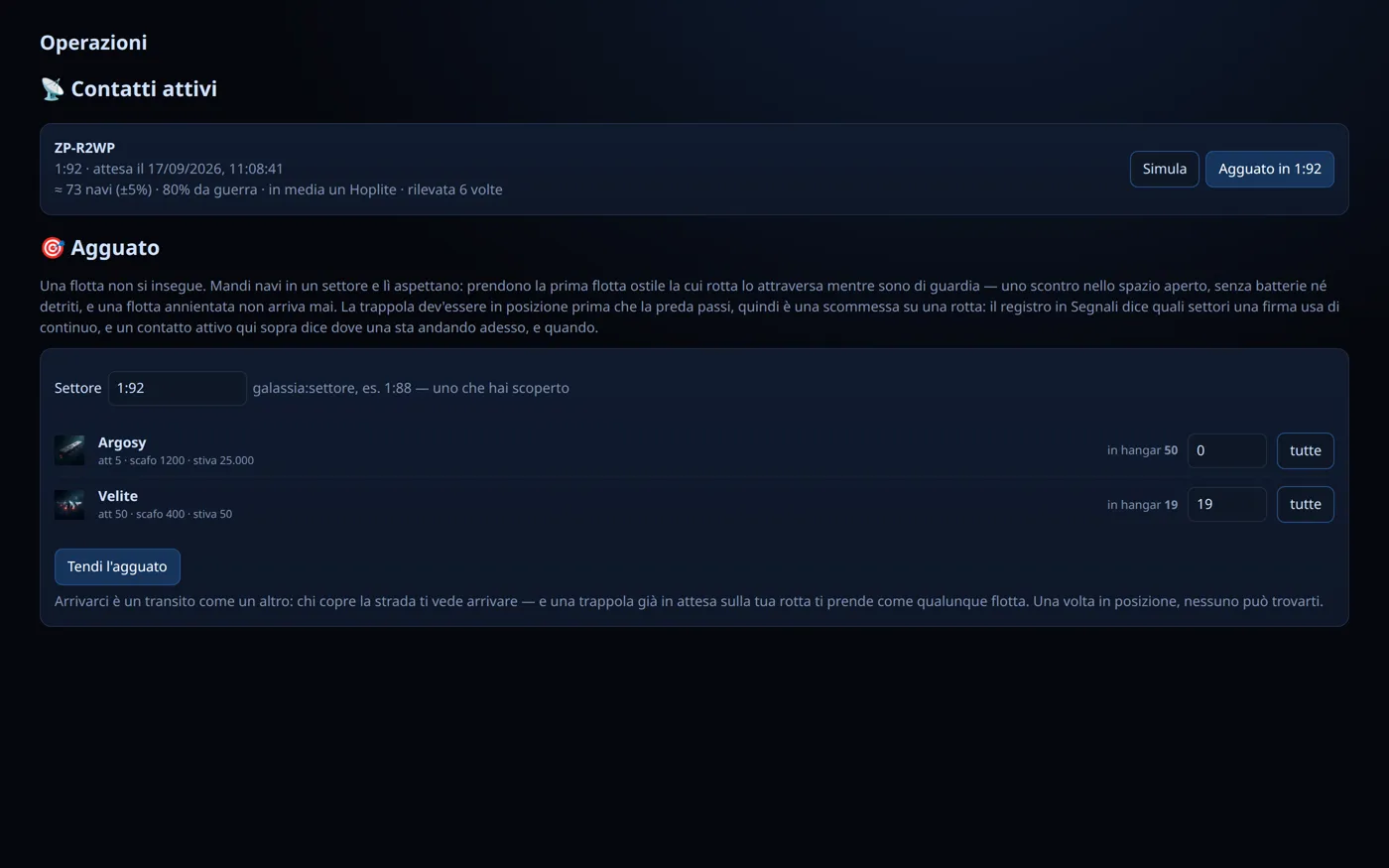
Attack, spy, recycle a debris field, survey an unknown sector, colonise an empty world, transport cargo between your own worlds or deploy a fleet to one of them. Journeys take real time and real fuel, and a fleet still outbound can be recalled — the fuel is spent either way. You can also lie in wait: an ambush is a bet placed in advance on a route you expect somebody to use, and it is the only way to hit something that is moving.
Logistics you can delegate — and be seen doing
Late in the research tree, the Dispensator lets your worlds supply each other: set the mines and power plants each world should reach, and it ships the difference between your own worlds and queues the next level when the cargo lands, at the hours you allow. It is not a bot: it runs the plan you approve and watches nothing. And every convoy is a real flight — a routine saves you time and tells your neighbours when to wait. Its first level runs the buildings; a second, at twice the price, also keeps each world's freighters and escorts topped up.
Whoever moves reveals themselves
Every player carries a permanent callsign, and a fleet crossing a sector somebody watches is logged there. At first it is only a signature — a stranger who keeps appearing. It becomes a NAME when you meet in battle or catch their ships on the ground with a probe, and once earned that name never fades, whatever they rename themselves. Against all of it there are counters, and none of them is a switch: emission control cancels sensor levels one by one, launching from a moon masks a departure, and a strike can be anonymous — to anybody who has not already earned your name.
Lie in wait, then decide how much to send
A fleet in flight can be taken only by a trap already waiting on its route. A live contact tells you where a fleet is heading and when; what it is made of you earn by rungs — its mass class, then a count with a stated error, then the share of warships, and every hull only at the top — and each sensor that logs the same fleet tightens the error. One button loads that estimate into the Simulator as the defender, sized for a bad day, so the question of how much to send has an answer before you commit.
The Expanse has a life of its own
Every day the universe decides how much happens in it, from how quiet it has been: derelict stations that power up at free worlds for a few days — guns, a garrison, a cache — and scavenger packs that park where fleets were loud and fall on anything crossing their sector. None of it is announced. You see it with your own sensors, at the same moment as everyone else who can, and striking it is heard across the sector. Nothing here is a player, and the rules say so.
Aim is earned in battle, and it rusts
Fresh crews miss one shot in five; a battery misses one in ten; an elite crew misses nothing. Crews climb only by destroying ships — in proportion to what the enemy was worth, so bullying teaches them nothing — and slip a rank after a week without a fight. A fleet that only hides behind its guns fights like a new one. And a war pays: a Warfare category on the leaderboard, a share of the plunder even in retreat, wreckage from broken batteries.
Alliances share the map, not each other
There is no directory of alliances: you discover one by discovering a member. Joining pools what everyone has explored — a living union, so leaving takes your sight with you — while where each member lives stays hidden until they choose to show it. Permissions are granted to one named person at a time and revoked the same way, and one of them is a shield: a garrison you station over an ally's world, which fights and dies there. Betrayal is never blocked, only recorded, and the victim decides what to do with the record.
Peace held by a threat
The Beacon is the game's deterrent. Aim it at a world whose coordinates you have earned and the target is told who is holding the sword — threatening somebody costs you your anonymity. Fire it and that world becomes reachable by everyone in the universe, with no scouting required, while every player feels a bearing and a distance from their own home. It stakes your world too, and it fades. Betrayal and moderation raise the same beacon permanently, which is what a reputation is here.
Talking to somebody is revealing yourself
You can only write to somebody you have discovered, or who has written to you first, and sending reveals your name to them — that is the whole price. Messages are encrypted where they are stored, alliances get a channel of their own that stops existing for you the day you leave it, and everything that happens to your worlds arrives as an alert you can dismiss. Your fleets' outcomes are kept in an archive: every scan you ever made, filterable, and strictly your own.
Research, and a tree that draws itself
Nineteen technologies in five branches, and every one of them does something — a bonus, a mechanic, or a gate that unlocks a hull or an emplacement. The tech tree page is built from the catalogues themselves, so it can never describe a game that no longer exists, and every hull, battery, building and technology carries a register entry: what it was built to answer, how it dies, what it costs at every level for the next forty. The first hour is a checklist of eleven objectives that tick from what you have actually done, in any order, and grant absolutely nothing.
And the ordinary comforts
It runs in a browser and installs on a phone; it exists in five languages; it can notify you that something is inbound without ever naming a place. Time passes while you are away — production, construction and fleets all advance — and a declared holiday freezes your domain so that nothing reaches it. Worlds can be renamed, the leaderboard lists only the rivals you have actually scouted, and the universe itself grows as more people arrive and contracts when they leave, without ever moving a world that somebody lives on.
And one thing this page does not describe There is a part of the game that is documented nowhere — not here, not in the rules, not on any page you can reach without playing. It is not hidden to be sold to you later and it grants no advantage to whoever finds it first; it exists because a universe you have been handed a complete map of is not a dark forest. You will get there by playing, or you will read about it from somebody who did.
Free to play until 31 December 2026. It takes an email and a password — the rest you have to earn.