
How to play
The rules, in full
Everything on this page is a rule — something the game does the same way for everybody, every time. None of it is a secret, and knowing it takes nothing from anyone: the tension here comes from not knowing what your neighbour HAS, never from not knowing how a battle resolves.
What this page is not. It explains the machinery, not the tactics. What to do with it — where to put your guns, when to move a fleet, how to be harder to read — is what players work out against each other, and it is the part worth playing for. The game walks you through the first hour itself; this is the reference you come back to.
A world is a place, not a number
Every world has an address — galaxy:system:position — and the position is the Nth planet counting outward from its star. Each system has its own star and its own orbital band, so no two are alike: some compact and scorching, some wide and frozen. A planet's distance from its star decides its temperature, how much sunlight it can harvest and what its ground yields. Those are properties of the world, not of the player, and they are what makes one address worth more than another.
The surface is a real sphere. You build at a point — a latitude and a longitude you choose — and nothing may stand within a minimum distance of anything else. That choice cannot be taken back, and it is the choice the whole of combat rests on. A battle leaves debris in orbit, and out of a large enough field a moon can condense: a second body at the same address, with a surface of its own to arm.
Ground is finite, and that is the point
A world holds a fixed number of fields, usually between 200 and 300, and how many a particular world has is worth knowing before you settle it. Every level of a building costs a field — a level-30 mine occupies thirty of them, not one — and each defence emplacement costs one as well, however many guns you eventually stand on it. A fully developed economy fills most of an ordinary world, so what you build is a real choice against what you then cannot.
There are two ways out of a world that has run out. One late building carves five further fields per level, and it is priced steeply on purpose, because a world you can always extend has stopped having a size. Or you tear something down: one level at a time, into the same queue, taking half as long as raising it did — and giving back nothing at all. The resources stay spent and the points go with the level.
Two ways to keep the lights on
Mines run on power, and a mine without it produces at a fraction of its rate. Solar is free light and collapses as you move away from the star; fusion ignores the star entirely and burns fuel — and cold worlds happen to be rich in exactly that fuel, which is what makes the outer dark liveable instead of a dead end. A third source is not a building at all: orbital collectors cost no ground, and because they are ships, a probe sees your whole grid and a raid can switch it off.
One thing at a time
A world builds one thing at a time, with up to ten more lined up behind it. Research is account-wide — it follows you to every world you will ever own — and runs one study at a time, also ten deep, capped per account rather than per world. The shipyard builds one batch at a time and delivers unit by unit. Everything is paid for the moment it is queued, so a queue is a set of purchases, not a set of intentions.
Where you land decides the battle
This is the rule the whole game is built on. A defence emplacement sits at a point on the sphere and covers an arc around it — and when a fleet lands, only the emplacements whose arc covers the landing point fire at all. The same fleet, on the same world, two hundred kilometres apart, is a massacre or a walk. A short-ranged battery covers a few per cent of a world; the heaviest covers just under a quarter of it and no more.
The share of a world each engagement arc actually covers — the same figure the resolver uses to decide which guns fire at a landing.
Stationed ships obey no such rule: they are the mobile reserve and defend wherever the enemy comes down — and they can be destroyed doing it, where batteries mostly rebuild. So a fortress on one face leaves the other side open, spreading thin covers everything weakly, and a fleet at home covers all of it once. There is no correct answer, only the shape you chose and the one your attacker guessed.
What a probe will tell you
You can read nothing live about another player's world. The only way to learn anything is to send probes — and what comes back depends on your reconnaissance research against theirs, plus a bonus for the number of probes that survive. A defended world shoots down precisely the probes that would have deepened the report.
| Tier | Effective gap | What comes back |
|---|---|---|
| 1 | any | Resources only. |
| 2 | ≥ 0 | Resources, and the fleet on the ground. |
| 3 | ≥ 2 | Adds the defences — how many guns, and of what kind. |
| 4 | ≥ 4 | Adds the buildings, so the whole economy can be read. |
| 5 | ≥ 6 | Complete: the position of every structure and the arc each gun covers. |
Probes make up for a gap only up to a limit, so technology stays necessary: the deepest tier — the one that hands you the coordinates of every gun and the arc it covers, and therefore the one that lets you choose your landing point — cannot be reached by weight of numbers alone. Everything below it tells you a world has forty batteries and not where they are. And a report is a photograph: come back to it a month later and it still gets your fleet to the target, you just arrive not knowing what has been built since.
Test the raid before you send it
The Simulator is where a raid is rehearsed: your fleet on the left, the enemy on the right — batteries, a stationed fleet, their three combat researches and the resources in their silos, all of which a deep enough espionage report fills in for you — and sixty seeded battles resolved with the game's own resolver, at no cost. It uses your technology and spends nothing.
Three plans in the bar at the bottom answer the question you actually have, and all three start from your hangar: what you own goes first, and the page lists only what is left to build. Minimal fleet is the cheapest fleet that gets through and pays; Maximum fleet the cheapest that loses nothing and carries all the loot; Best fleet the cheapest that brings home at least 80% of the extra gain the maximum would. The bar every plan must clear is three rules at once, in every one of the sixty battles: the field is cleared and somebody comes home; the wrecks you can recycle — a fifth of the ferrite and silex of every ship destroyed, on either side — plus the loot cover what you lost; and the survivors have the hold to carry that loot, which is why a freighter may end up in the answer before a hundred fighters do.
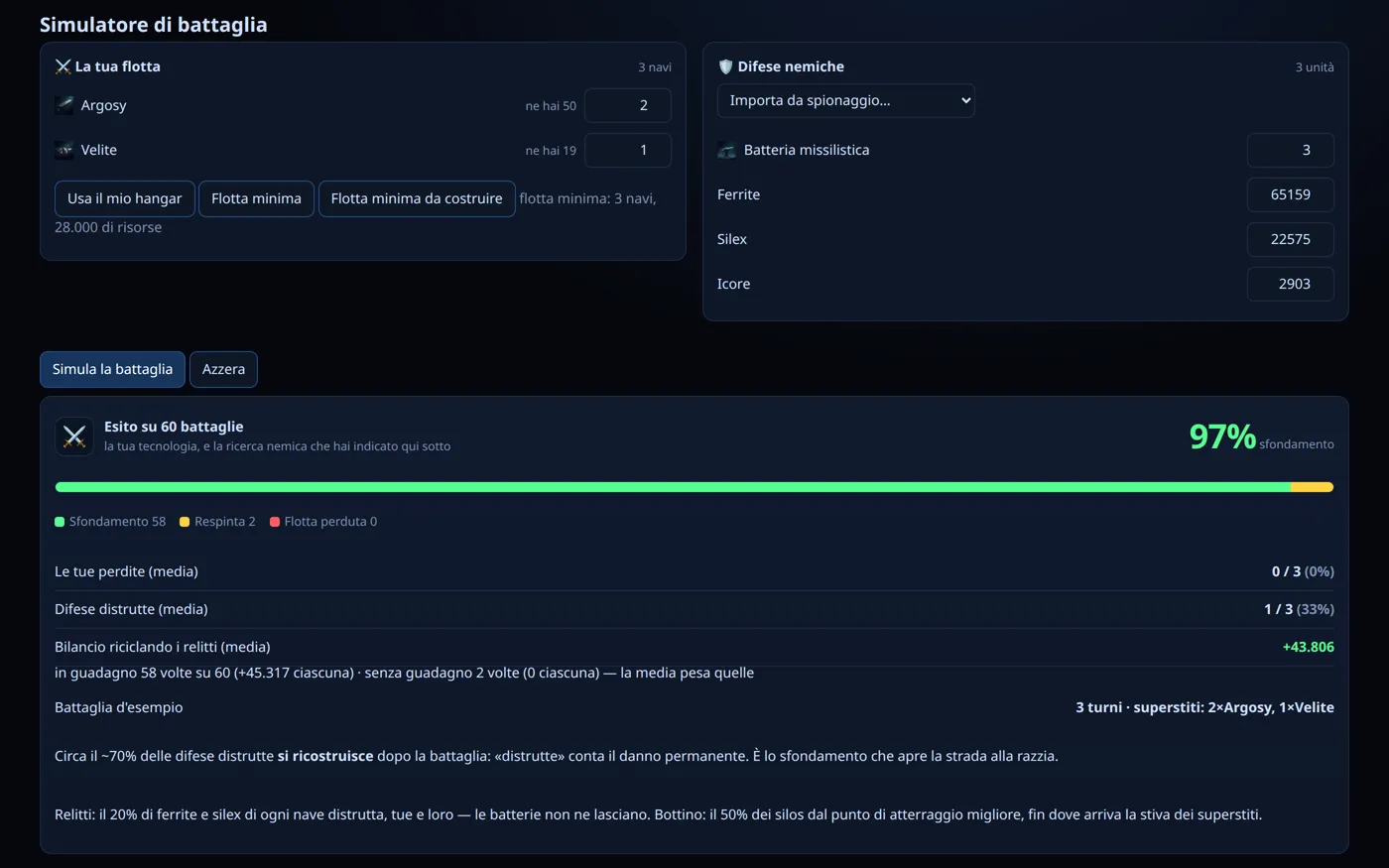
The result card then tells the truth about the money: in profit so many times out of sixty and by how much each time, and at a loss how many — because an average that hides one lost fleet in fifty-nine clean runs is the kind of number that sends people to their ruin. None of this reveals anything about anybody: it is your own Simulator, run in a loop over what you typed or earned.
Aim and rank
Every shot hits with a probability. A battery's is fixed; a ship's is its commander's rank, earned only by destroying ships and weighted by the enemy's worth against yours. A week without such a battle costs one rank. Another commander's rank is read by a complete espionage report.
| Rank | Experience | Hits |
|---|---|---|
| Green | 0 | 80% |
| Blooded | 25 | 85% |
| Seasoned | 150 | 90% |
| Veteran | 600 | 95% |
| Elite | 2000 | 100% |
A battery hits 90 of its shots, whatever its owner has fought.
The map is dark, and it stays dark
There is no list of who lives where, no directory of players and no map waiting to be opened. You see the sectors your sensors reach — a radius that doubles with every research level — plus whatever you have gone and looked at with a buoy, plus every sector a fleet of yours has crossed. A galaxy you have never touched is a smudge with nothing legible in it. What your sensors watch continuously never goes out of date; a sector you merely photographed once does, and the game then stops naming who lives there until you look again.
Seven things a fleet can be sent to do
Attack lands at a point you choose. Espionage reads a world and comes home, and only probes may fly it. Survey sends a single buoy at an unknown sector and is consumed doing it. Colonise founds a world you then own. Recycle gathers a debris field. Transport carries resources between your own worlds and returns; deploy leaves the ships where they land. Every one of them spends fuel out of the fleet's own hold, and every one of them is a journey somebody may be watching.
Whoever moves is written down
Every player carries a permanent callsign that never changes — not on renaming, not ever. When a fleet of yours crosses a sector, anyone whose sensors cover that sector may log the callsign that passed, and their chance of it rises with their research. They will not know whose it is: a callsign becomes a NAME only when somebody earns the connection, in battle or by catching your fleet on the ground with a probe. Once earned it is permanent. You can change what you are called; you cannot shed where you have been.
Hitting a fleet that is moving
You cannot chase a fleet. What you can do is lie in wait: send ships to a sector and they hold there for a fixed watch, engaging the first hostile fleet whose route crosses it while they wait — a battle in open space, with no emplacements, no debris, and no arrival for a fleet that is wiped out. The trap must be in place before the prey passes, so an ambush is a bet on a route. The signatures register tells you which sectors a callsign keeps using; a live contact — a fleet your sensors caught while it is still flying — tells you where one is heading right now, and when it is due. Getting to your sector is a journey like any other: whoever covers the way sees you coming, and a trap already waiting on your route takes you too. Once in place you are still, and nothing in the game can find a fleet that is not moving.
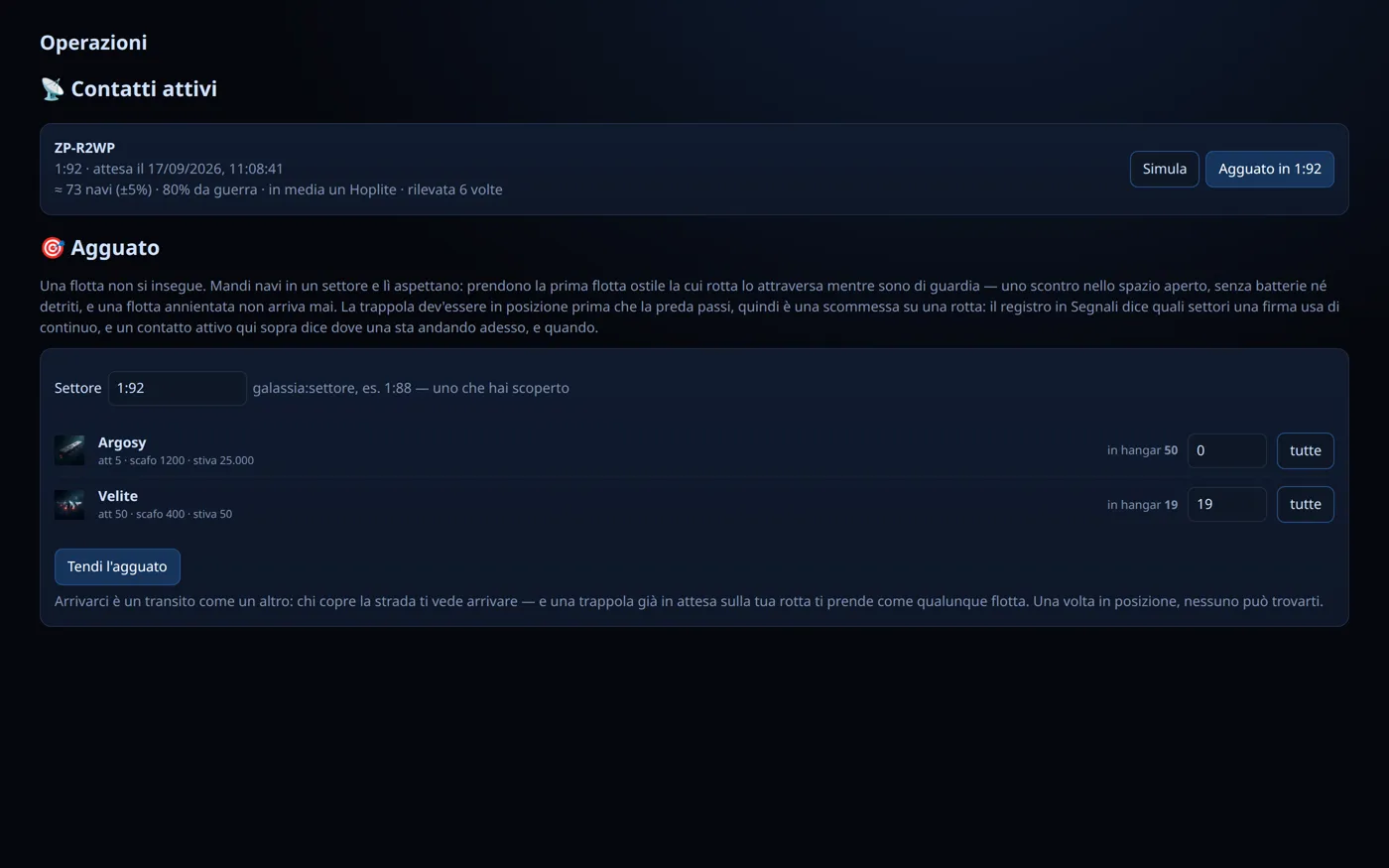
What the fleet is, you earn by rungs. Your reading of a contact depends on your sensors plus the sector's brightness plus the fleet's own mass, minus the other side's emission control: at the first rung its class — civil when not one warship is aboard, otherwise military light, medium or heavy — then a count with a stated error, then the share of warships and the hull they average to, and only at the top every hull exactly. Each further sensor of yours that logs the same fleet tightens the error, which is what a chain of sensor arrays along a route is for. The register remembers the mass class of every crossing, so a callsign reads as mostly civil, last military heavy. And mass is noise: a large fleet is easier to catch than a probe, by the same currency as a bright star — the more you move, the more you are seen.
Share the map, not yourself
An alliance pools vision — the union of what its members have explored — and that is the good worth staying together for. It does not reveal the members: your position stays hidden even from your own alliance until you explicitly share it. There is no public list of alliances either; you discover one by discovering one of its members. Nothing prevents betrayal, because a lock would be a lie about a universe like this one — but striking somebody who trusted you is recorded, permanently, and handed to the people who most want to know.
Peace held by a threat
The Beacon exposes one world to everybody at once: no scouting needed, anyone can reach it. It is what a betrayal earns, what moderation uses as its heaviest sanction, and what you can aim at somebody yourself once you hold their coordinates — declared, so they know who is holding it, and mutual, so firing it stakes one of your own worlds too. That is the whole of the peace here: not a treaty and not trust, just a cost nobody wants to pay first.
One more thing. There is a part of this game documented nowhere — not here, not in the game, not by us. It is found by playing, and everything above is true without it.
Free while the universe is young. No card, no download, five languages.